Rage is Not a Strategy
What Homer understood about war that Pete Hegseth seems to have forgotten.
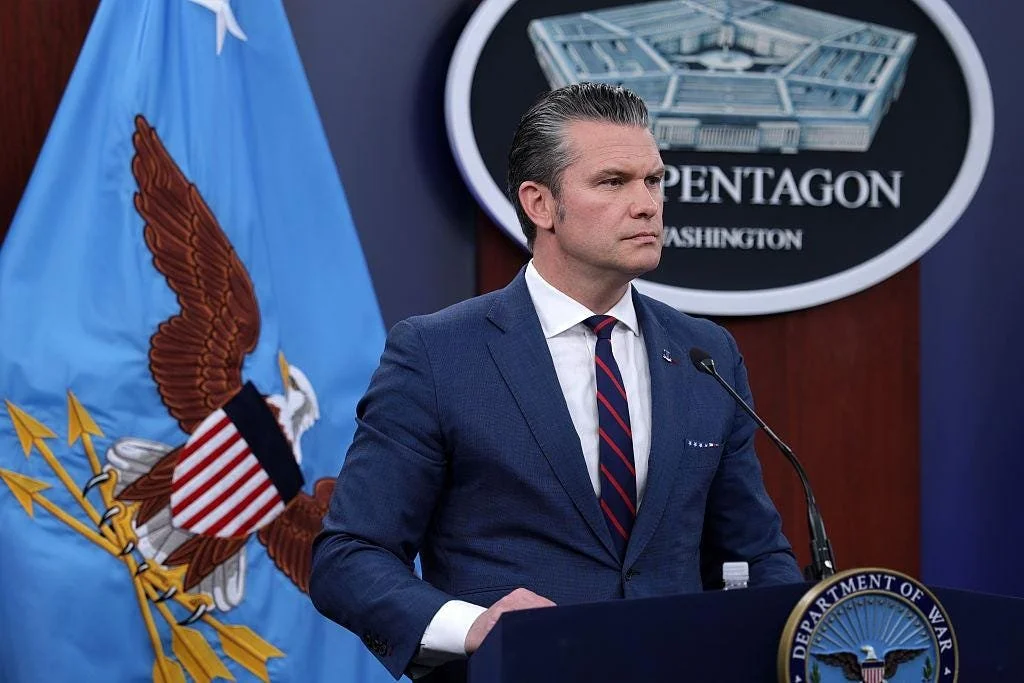
Military power can win battles without winning wars. Homer understood that victory requires more than overwhelming force. As the Iran war continues, the question is whether America’s defense secretary understands the difference.
Homer wrote two poems about the Trojan War, and the second one exists because the first one ends in failure. The Iliad closes with Hector dead and Troy still standing. Ten years of siege, the greatest warrior of the age raging through the Trojan lines, and the city does not fall. Achilles’ rage wins duels. It does not win the war.
The war ends because of a different kind of man. Odysseus , patient, deceptive, willing to wait inside a wooden horse in the dark for a city to let its guard down, conceives the stratagem that a decade of pure martial fury couldn’t produce. And Homer, tellingly, doesn’t let him enjoy it. At the Phaeacian court, a bard sings the story of the horse back to him as legend, and Odysseus weeps and hides his face, compared to a woman watching her city burn. The architect of victory can’t listen to his own triumph without breaking down. That is the cost the poem attaches to actual strategic competence: you don’t just win, you must then live with what winning required.
Pete Hegseth has spent his public career in Achilles mode, and he has never had to build a horse.
His formative military experience was under Colonel Michael Steele, whose brigade in Iraq contained a company of soldiers nicknamed “Kill Company,” and whose command style eventually produced a formal Army reprimand over the killing of unarmed detainees , a reprimand that ended Steele’s career. Hegseth’s own writing since has treated that ethos as the answer rather than the warning: American troops, he has argued, need to be unleashed to be “the most ruthless, the most uncompromising, the most overwhelmingly lethal” they can be. As Defense Secretary, he has told his senior leadership that revitalizing “warrior culture” means grooming standards and purging “woke” politics, not, by his own account, a new strategy for any specific adversary. That is Achilles’ answer to every problem: more rage, more lethality, more purity of aggression. It has never been Troy’s answer. It still isn’t.
The Iran war is the live test, and it is failing in exactly the place the Iliad predicts it would. Hegseth opened the campaign in full triumphalist register: Iran’s military “neutralized” faster than any in recorded history, a “decisive campaign” with clear objectives, regime change effectively declared. That is the language of a man announcing the city has fallen. But seven months in, the actual record looks like a siege that never resolved: a naval blockade Hegseth now describes as sustainable “indefinitely,” rotating ships in and out of a standoff neither side can end; Iran’s own maritime authority insisting the strait stays shut until sanctions lift; the President reportedly confronting his own defense secretary at Camp David over munitions shortages he says he wasn’t told about; and a sitting Senator telling Hegseth to his face, in a hearing, that he has no strategy and no long-term plan to actually win. That is not a horse inside the walls. That is Achilles still raging at the gates, mistaking volume for victory.
The deeper failure isn’t tactical. American munitions, American airpower, American lethality are not in question; the strikes happened, the casualties were real, the spectacle was genuine. What’s absent is the Odysseus function: the willingness to sit with a problem that force alone cannot solve, to read the political terrain the way Odysseus read Polyphemus’s cave, to plan for the return voyage, and not just the initial assault. Critics across the political spectrum have converged on the same diagnosis without needing Homer to say it ; that Iraq and Afghanistan were not lost for lack of ferocity, and that Iran’s sectarian fractures, its paramilitary depth, its regional entanglements are exactly the kind of problem lethality cannot brute-force into resolution. Hegseth’s own rhetoric suggests he doesn’t believe that critique applies to him, which is itself the tell. Achilles never thought he needed a different kind of mind. That is precisely why the war outlived him.
There is one more detail in the epic worth sitting with. Odysseus wins because he is willing to be someone the Cyclops calls “Nobody;” to swallow his ego for the length of the ruse, to accept smallness and patience as the price of getting his men home. It is only afterward, sailing away, that his pride gets the better of him and he shouts his real name back at the monster, undoing the discipline that made the trick work in the first place and inviting a decade of disaster down on his own head. Hegseth has never experienced the Nobody phase. He has never had to be small, patient, or anonymous in service of a strategy larger than his own reputation. He has only ever had the shout; the name, the boast, the “wall of steel,” the demand that the cameras get it right. Whether that is sufficient to end a war that has already outlasted his own early declarations of victory is the question Washington is now actually living through, seven months and counting. Homer answered it three thousand years ago. Rage built no horse. It never does.
Based on the Author’s original version. published in the Medium, September 2026.
Founded in 2016, The Steady State is a nonprofit 501(c)(4) organization of more than 450 former senior national security professionals. Our membership includes former officials from the CIA, FBI, Department of State, Department of Defense, and Department of Homeland Security. Drawing on deep expertise across national security disciplines, including intelligence, diplomacy, military affairs, and law, we advocate for constitutional democracy, the rule of law, and the preservation of America’s national security institutions.