Putin wants to rewrite the order of European security. Why is Washington helping him?
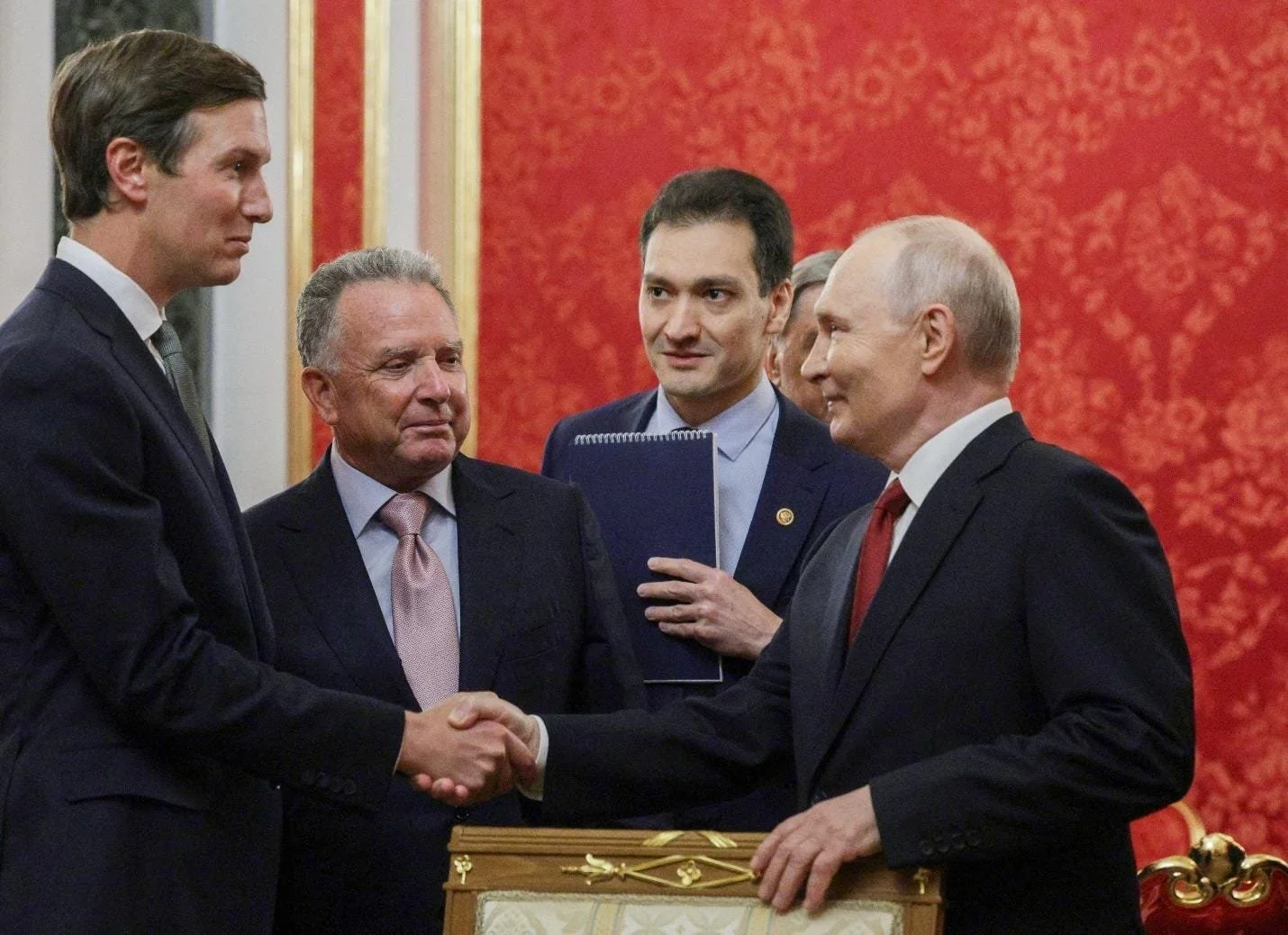
There is something particularly troubling about the Trump administration’s latest approach to negotiations over Ukraine. It is not simply that President Trump continues to make concessions to Vladimir Putin, or that his administration seems increasingly willing to accommodate Russian interests. It is that American negotiators are now entertaining one of the Kremlin’s longstanding strategic objectives: a fundamental reordering of European security.
Ahead of the latest round of Ukraine peace talks in Abu Dhabi, the Trump administration announced that discussions would include a broader European security architecture. In other words, negotiations ostensibly intended to end Russia’s war against Ukraine are now expanding to encompass the future security arrangements of an entire continent. This is not a minor negotiating adjustment. It is a major departure from longstanding American policy, and it is precisely what Moscow has wanted for years.
This is what Putin has been asking for
For decades, Putin has argued that Russia should have a privileged voice in determining Europe’s security arrangements. His government has repeatedly demanded restrictions on NATO’s presence in Eastern Europe, limits on the military capabilities of countries that joined NATO after 1997, and assurances that Ukraine would never become a member of the Alliance.
In December 2021, just months before launching his full-scale invasion of Ukraine, Moscow presented Washington and NATO with proposed security agreements that would effectively have rolled back NATO’s military presence and influence in much of Central and Eastern Europe. The United States and its allies rejected those demands because they would have undermined the sovereignty of independent European nations and the fundamental principle that countries have the right to choose their own security arrangements.
That principle is embedded in the 1997 NATO-Russia Founding Act and the 1999 OSCE Charter for European Security, both of which Russia endorsed. The latter explicitly recognizes every country’s right to choose its own security arrangements, including alliances, and rejects the idea that any country can regard part of Europe as its sphere of influence.
Now, somehow, we have arrived at a point where American negotiators are prepared to put the broader European security order on the table as part of negotiations to end Russia’s invasion of Ukraine.
There is nothing wrong with discussing mechanisms to reduce the risk of conflict between Russia and the West. Those discussions have been part of European diplomacy for decades. But that is very different from allowing Moscow to use its invasion of a sovereign neighbor as leverage to reopen the fundamental question of who gets to decide Europe’s security arrangements.
As European officials have pointed out, Europe already has a security architecture: NATO, the European Union, and the agreements governing relations among participating states. The problem is not the absence of a security system. The problem is that Russia has repeatedly violated it.
It’s not just the negotiators. It’s what they are ignoring.
Which brings us to Steve Witkoff and Jared Kushner.
Neither brings any diplomatic or national security experience to negotiations of this magnitude. Witkoff is a real estate developer. Kushner is Trump’s son-in-law. I may not be the smartest guy in the world, but even I can figure out that negotiating a commercial transaction and negotiating the future of European security are fundamentally different undertakings.
This is where the administration’s approach becomes particularly difficult to understand. The United States has extraordinary depth of expertise on Russia, Ukraine, NATO, and European security. Though decimated by layoffs, the State Department still has some career diplomats and regional specialists who have spent decades working on these issues. The National Security Council, intelligence community, and Department of Defense, though also victims of DOGE layoffs, have professionals whose job it is to understand Russian strategic objectives, anticipate consequences, and assess the implications of proposed agreements.
These are precisely the people who should be informing and guiding negotiations of this importance. Instead, the administration appears to have substituted personal relationships and business instincts for what remains of institutional knowledge and professional judgment. As former Assistant Secretary of State for European Affairs Dan Fried told the Washington Post, “Anyone could have told them that talking about postwar European security architecture is a Kremlin talking point,” he observed. Former NSC official Eric Ciaramella was similarly critical, describing the negotiators as people who were essentially taking an undergraduate course in European security for the first time.
That is an extraordinary indictment of the way the U.S. is conducting diplomacy. It is not simply that these two men lack experience. It is that the administration has access to people who understand the history, the players, the competing interests and the potential consequences, but they are unwilling to make use of their expertise. It is particularly dangerous when the people across the table are experienced Russian officials who understand exactly what they want.
This is not just about Ukraine
The consequences extend far beyond Ukraine. Europeans have every reason to be alarmed at the prospect of their security being discussed as part of a bargain with the very country that has violated their borders, threatened their neighbors, and repeatedly demonstrated its willingness to use military force to achieve political objectives. And what message does this send to Ukraine? That its sovereignty and security can become bargaining chips in a much larger negotiation over Russian influence in Europe.
American leadership in Europe has historically rested on something more substantial than military power or economic leverage. It rested on alliances, credibility, expertise, and a commitment to the principle that international borders cannot simply be redrawn by force. Of course, a diplomatic end to the war should be pursued. But ending the war cannot mean rewarding Russian aggression by giving Putin a voice in determining the future of countries that have never consented to Russian influence.
Putin knows exactly what he wants. He has spent years pursuing it. The question is why the United States is allowing two businessmen without diplomatic and national security experience to negotiate issues of such historic importance while the people who understand those issues are left on the sidelines.
There are real-world consequences here, for Ukraine’s survival as an independent nation, for the security of every European country, for NATO’s credibility and obviously for our own national security.
Perhaps the most troubling question of all: does anyone in this administration understand what is being given away? Recent experience is not reassuring.
Founded in 2016, The Steady State is a nonprofit 501(c)(4) organization of more than 450 former senior national security professionals. Our membership includes former officials from the CIA, FBI, Department of State, Department of Defense, and Department of Homeland Security. Drawing on deep expertise across national security disciplines, including intelligence, diplomacy, military affairs, and law, we advocate for constitutional democracy, the rule of law, and the preservation of America’s national security institutions.