
A lawful alternative to the Pentagon’s lethal campaign already exists. Congress needs to know why it is being ignored.
U.S. Coast Guard
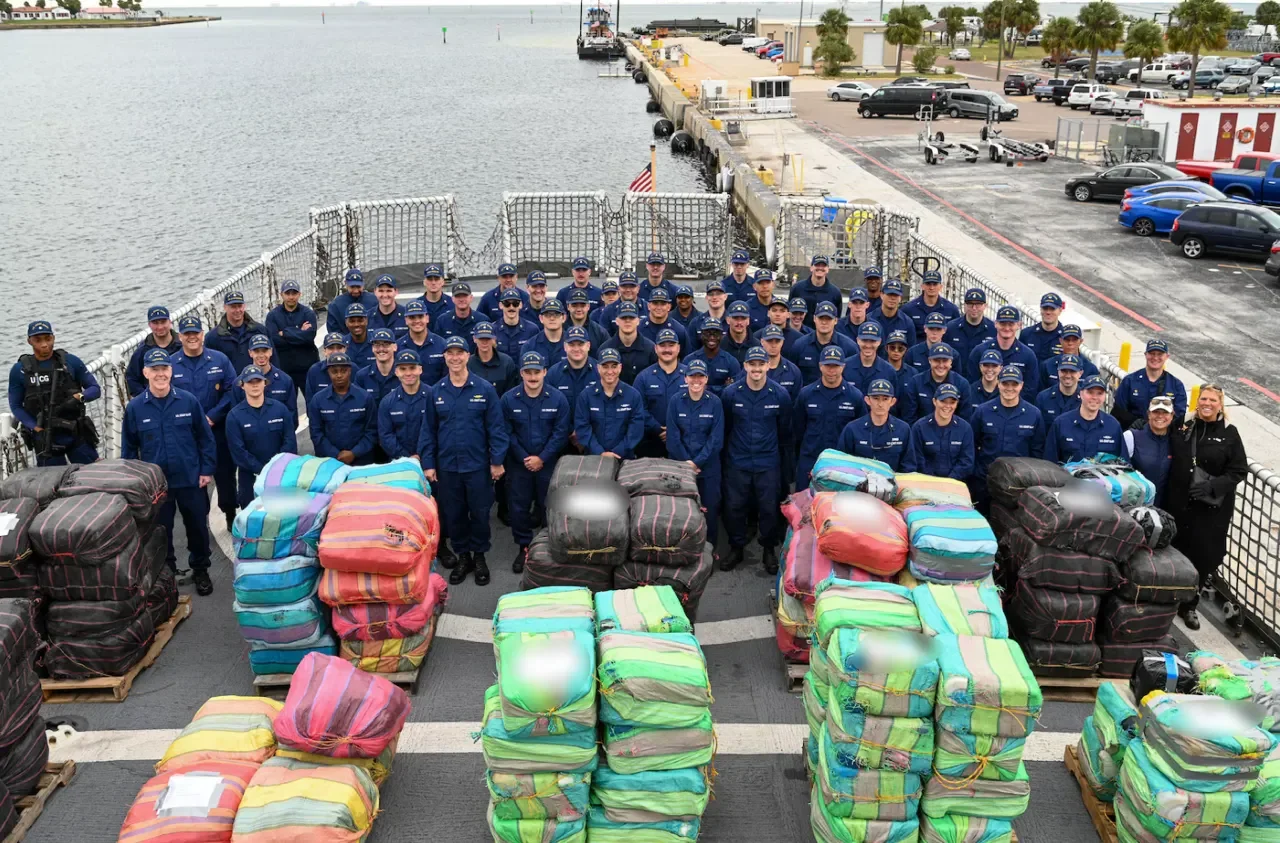
The Coast Guard has shown that drug-smuggling vessels can be intercepted, their cargo seized, and their crews brought into the legal system. The military’s alternative, killing suspected smugglers without publicly demonstrating the evidence or legal justification, demands congressional scrutiny.
The Congress sworn in next January will, without doubt, oversee the Executive Branch more actively than it has for the last two years. While the effort in the current Congress to impeach Secretary of Defense Hegseth failed, he and his department will surely come under intense scrutiny in the next Congress. The committees will have many matters to pursue, including the conduct of the war with Iran and the unexplained firing of dozens of experienced senior officers. To this very old soldier, though, the most troubling conduct of the U.S. military on Secretary Hegseth’s watch is the campaign of strikes against alleged drug-running boats in the eastern Pacific and the Caribbean. The administration has offered no public evidence for the strikes, no serious legal rationale, and no sign that they have reduced the flow of narcotics. A lawful alternative exists, and the Coast Guard has been using it for decades.
In the 14 months since September 2, 2025, there have been more than 70 strikes against suspected drug-smuggling vessels, killing at least 240 members of their crews. The administration says the strikes rest on intelligence, but none of that intelligence has been made public, even in sanitized form.
No drugs have been displayed after any strike to bolster the administration’s claims. No evidence has been produced that the quantity of narcotics reaching America’s streets has abated to any degree, and an internal Drug Enforcement Administration assessment obtained by the Washington Post found that the strikes have done little to reduce the supply or price of cocaine in the United States.
A campaign of killing, the justification of which the public is asked to take on faith, and whose results no one can point to, is exactly what congressional oversight exists to examine.
If this is a law enforcement operation, the military should not be involved in it, other than in a supporting role. If it is a military operation, there are clear violations of the law of war to which the United States has subscribed for many decades. Neither characterization rescues the campaign.
The administration has not tried very hard to produce a legal rationale for the strikes, and no wonder. Early in his tenure, Secretary Hegseth fired most of the senior Judge Advocates General (JAGs) and Inspectors General of the services, so whatever legal advice he gets, if any, is much less authoritative.
No one could object to lawful interdiction of the flow of narcotics into the United States, and there are lawful ways to do it. As four retired senior Coast Guard officers recalled in an October 27, 2026 article in Just Security, “When Military Leaders Fear Speaking Up, Everyone Is at Risk,” the United States has long relied on maritime interdiction, evidence preservation, prosecution, and cooperation with international partners to combat drug trafficking at sea.
The Coast Guard is the least appreciated and most underfunded arm of the U.S. military, though it falls under the Department of Homeland Security. It uses its law enforcement authorities to interdict drug boats hundreds of miles at sea, and in 2025 it seized drugs valued at $2.2 billion in maritime interdiction operations. It displays the contraband after an operation. It does sink smuggling vessels, but after removing the drugs and the crew, who are then subject to one or another type of legal proceeding. It also reports on what could be called “dry holes.” In its 2024 report, the Coast Guard said that 27 percent of the interdiction operations it conducted that year did not result in “drug disruption.” One wonders what the corresponding statistic is for the military’s kinetic strike operations.
The Coast Guard routinely puts detachments with law enforcement authority aboard U.S. Navy ships, which is the correct use of military assets in support of a law enforcement operation. U.S. Southern Command showed it could be done when it boarded a suspect boat in early September and transferred the crew to Ecuadorian authorities before sinking the boat. No evidence was produced publicly in that case that the boat was involved with drugs. Since then, the “Department of War” has seemingly reverted to its default approach of “shoot first, don’t ask any questions at all.”
A United Nations brief in September reached the same conclusion on legal grounds:
“The United States’ attacks could not be considered necessary or proportionate in response to any supposed armed attack, since alternative means were available to effectively respond to the threat.”
The Coast Guard officers refer briefly to the moral risk faced by those who carry out the strikes. The harm at stake is moral injury: the lasting psychological, emotional, and spiritual damage that accompanies actions, or failures to act, that violate a person’s moral beliefs. In combat, that might mean killing in ways that feel wrong, harming civilians, or witnessing others commit acts one cannot stop. The risk is just as real for the sailor who operates a drone from a ship and sees his targets on a video screen as for the infantryman who experiences combat up close and personal.
It is puzzling that no one in the kill chain has stood up to say that these orders are illegal and immoral. The title of the Coast Guard officers’ article points to part of the answer: when those in uniform fear speaking up, they may stay silent.
Interdicting narcotics is a legitimate mission critical to our national interest, and a lawful way to carry it out already exists. The responsibility does not stop at the Secretary. Arguably, many military personnel, from the four-star combatant commander to the drone operator who pushes the “fire” button, are at legal risk if they travel to a foreign country. No matter how it is parsed, orders to kill civilians, even drug-running civilians, are patently illegal and immoral.
The sailors, airmen, and soldiers in the kill chain are owed orders they can carry out without lasting moral injury. Killing suspected smugglers on the strength of undisclosed intelligence is something else; To date, the republican majority in Congress has been silent. The new Congress must fulfill its Constitutional responsibilities.
Founded in 2016, The Steady State is a nonprofit 501(c)(4) organization of more than 400 former senior national security professionals. Our membership includes former officials from the CIA, FBI, Department of State, Department of Defense, and Department of Homeland Security. Drawing on deep expertise across national security disciplines, including intelligence, diplomacy, military affairs, and law, we advocate for constitutional democracy, the rule of law, and the preservation of America’s national security institutions.