
The Greeks Had a Word for Trump’s America
Questionable appointments and potential conflicts of interest are undermining the integrity of American diplomacy.
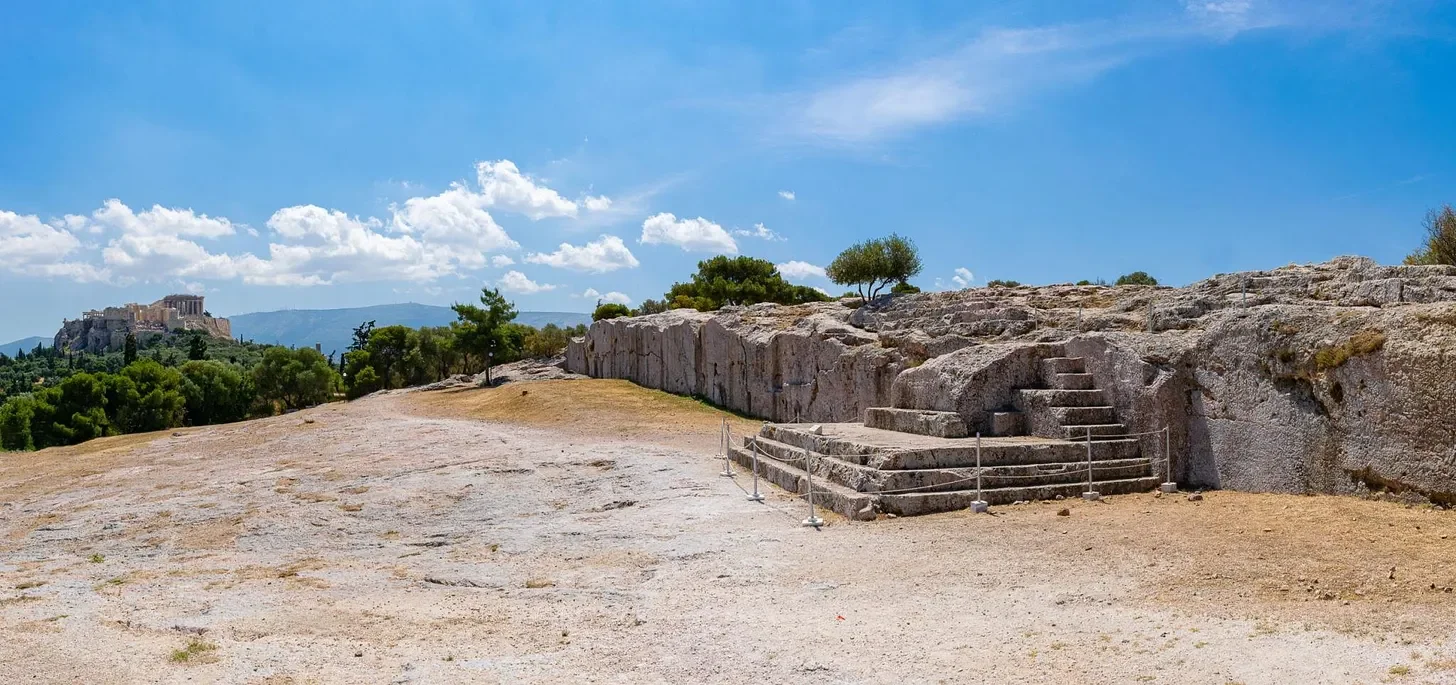
The Pnyx steps, “where democracy was born.” Photo: HolyLandPhotos.org
Marco Rubio invokes the Greek legacy to promote a Trumpian version of Western strength, but neglects the Greek warning about excessive pride and unchecked ambition. The founders built constitutional checks to guard against those dangers. Their warning matters more than ever.
Secretary of State Marco Rubio recently spoke in Athens, specifically in the Pnyx, where ancient Athenians met to practice their version of democracy.
Rubio, heretofore not known for his deep interest in the classics, spoke of what he thinks are the close ties between America and the ancient Greeks, and what we owe to Athens and Greek civilization: great works of literature, philosophy, mathematics, and science, and democracy itself. Rubio used the Greeks to argue that the Trump administration embodies virtues supposedly lost by Americans and, especially, Europeans.
These virtues include self-confidence, individualism, heroism, innovation, self-sacrifice, and the use of force to defend our way of life. Rubio claims these virtues once defined the West but have since weakened, leaving us spending too little on defense, overwhelmed by immigrants, and deferential to multinational organizations.
Rubio’s Objective
What is Rubio trying to accomplish by reaching back to ancient Greece? Here’s the real aim: to convince the world that the Trump administration’s assaults on democracy, the rule of law, and common decency are somehow grounded in traditional Western values.
Rubio serves a President and a movement that exploits fears of “weakness” to glorify performative toughness. Their model of strength is the playground bully, threatening smaller countries, Venezuela, Greenland, and Canada, while avoiding anyone who might fight back, like China or Russia. And claiming this is consistent with classic virtues and American tradition is another example of a Big Lie, like Trump’s endless lies about the 2020 election.
Rubio was, until recently, himself a firm supporter of America’s alliances and its leading role in supporting democracy and freedom around the world. He now hopes that spouting off about ancient Greek virtues will make us forget his abandonment of those principles. It will come as no surprise to learn that disguising self-interest as virtue is how dictators everywhere gain popular support.
Rubio invokes a Greek term to sum up what the Greeks had, and we supposedly don’t: thumos, often translated as “spiritedness.” Thumos is a concept that incorporates pride, honor, and courage, but also aggression, selfishness, and the desire for power. It is not an unalloyed good, but as Plato and the Greek tragedians consider at length, a part of human nature that is necessary but must be properly controlled.
What happens when thumos is not kept within limits is described by another Greek word that Rubio should have used but didn’t: hubris, excessive pride and self-confidence. Hubris is a permanent danger in human affairs, especially for people and regimes that have gained power and wealth.
It is characteristic of the Greeks that they could acknowledge and describe their own failings. It was hubris that Thucydides tells us brought down classical Athens. Athens was the wealthiest and strongest of the Greek city-states, but it alienated its allies with ever-increasing demands for tribute, then followed the call of an ambitious populist, Alcibiades, to mount an invasion of Sicily that swallowed its resources and ended in disaster. Sound familiar?
The founders knew the classics
Rubio notes that Plutarch, the famous Greek biographer, is the writer most often cited in the Federalist Papers. The founders knew the classics well, but that does not mean they viewed Greek politics as a model for America. Rubio would have been on firmer ground had he read what Alexander Hamilton had to say in Federalist #9: “It is impossible to read the history of the petty Republics of Greece and Italy, without feeling sensations of horror and disgust at the distractions with which they were continually agitated, and at the rapid succession of revolutions, by which they were kept in a state of perpetual vibration, between the extremes of tyranny and anarchy.”
When it came to politics, the Greeks were models not of what to emulate, but of what to avoid. The Greeks failed to rein in thumos and ended up squandering their collective strength in civil wars and internal divisions. This made them vulnerable to foreign domination, first by the Macedonians, then the Romans. The challenge seen by the authors of the Federalist Papers was to restrain the antagonistic spirit and channel it productively. As Madison wrote in Federalist 51, constitutional checks and balances ensure that “ambition must be made to counter ambition.”
Rubio, like many conservatives, bemoans what he sees as a loss of Western confidence: “Over time, we in the West came to feel ashamed of the very things that made us exceptional.” It is hard, however, to look at 20th and 21st century history and think the ‘West’ suffers from a shortage of thumos. Our challenge has not been to revive our flagging animal spirits, but to keep aggression and the lust for power from destroying civilization.
Until recently, America embraced this task, helping build the international organizations and alliances that followed World War II. Trump has sought to dismantle them and reduce international relations to “who has the cards.” That crude realpolitik helped bring down Athens. It could do the same to us.
Founded in 2016, The Steady State is a nonprofit 501(c)(4) organization of more than 450 former senior national security professionals. Our membership includes former officials from the CIA, FBI, Department of State, Department of Defense, and Department of Homeland Security. Drawing on deep expertise across national security disciplines, including intelligence, diplomacy, military affairs, and law, we advocate for constitutional democracy, the rule of law, and the preservation of America’s national security institutions.