
The Flags Are Up. The Fallen Are Hidden.
Nearly 200 American flags now conceal the names of 321 fallen diplomats. This is not a tribute to American greatness; it is a failure to honor those who served it.
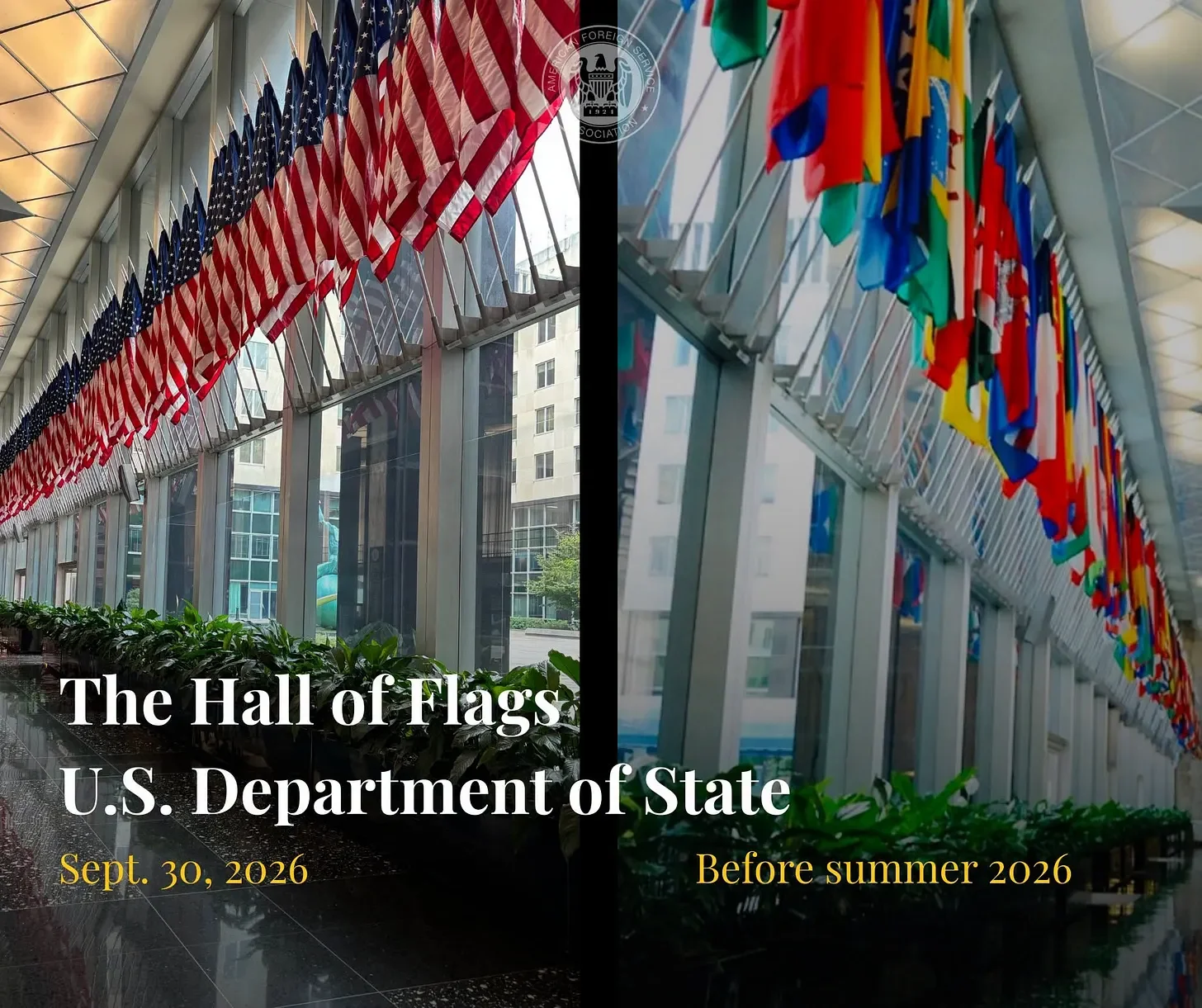
Photo: American Foreign Service Association
Nearly 200 American flags now cover a memorial to 321 diplomats and Foreign Service personnel who died in the line of duty. In an administration with a record of reported disparagement of fallen military personnel, the concealment sends a message that patriotic spectacle matters more than honoring those who served.
For decades, anyone who entered the C Street entrance of the State Department – foreign visitors, foreign diplomats, U.S. officials, Congressional members or staff, or the general public – immediately saw a proud array of almost 200 flags of all the countries with which the United States has diplomatic relations. Now those flags are gone, replaced by almost 200 American flags.
Supporters of that change believe it underscores American greatness. In fact, the opposite is true. As stated in President Trump’s first-term National Security Strategy (which he signed, even if he never read it), America’s friends and allies magnify our power. Isolation is a huge source of weakness; much of our power comes from our worldwide engagement. The flags that once hung inside the main State Department entrance thus testified to American greatness. The current flags testify to how much we have lost.
The large array of American flags facing those who arrive at the State Department has received some public attention, even if not nearly enough. But there is another aspect to this change which is worse, and which to my knowledge has received no public attention.
Since the current State Department building opened in 1961, plaques on the west and later east walls of the C Street entrance have displayed the names and causes and dates of death of initially diplomatic and consular officers, and, for the past century, Foreign Service officers, who died in the line of duty. There are 321 people listed; the first was in 1780. The plaques underscore the long and honorable history of U.S. diplomacy, and of the cost paid by many unsung heroes. The numbers are small compared to those of our military, but they too show a devotion to duty and willingness to sacrifice.
The most shocking, dismaying aspect of this year’s renovation of the C Street lobby is that those names are no longer visible. Instead, they are hidden from view by two large American flags. It is bad enough that the State Department leadership no longer wants to show pride in America’s role in the world. But it is beyond horrifying that it no longer wants to honor its dead.
While the covering up of the State Department memorial plaques was shocking, it should not have been surprising. The plaques were erected and have been maintained by the American Foreign Service Association (AFSA). Every year AFSA held a ceremony in the C Street lobby to remember those who had given their lives. Normally the Secretary or Deputy Secretary would speak at the ceremony. However, the Rubio State Department has illegally withdrawn recognition of AFSA as the Foreign Service union. This year it did not allow an in - person memorial ceremony to be held at the State Department. The remembrance was relegated to virtual attendance.
The covering of the State Department memorial plaques is also not surprising because it fits a Trump Administration pattern. In the President’s first years in office, he disparaged U.S. military dead. During a November 2018 trip to France to commemorate the end of World War I, Trump cancelled a planned visit to the Aisne-Marne Cemetery. Over two thousand American servicemen are buried there, most of them Marines who fought in the Battle of Belleau Woods. Lasting almost a month in June 1918, Belleau Woods was a major turning point in the war. Although the United States owed much to the two thousand brave and selfless heroes buried there, the President reportedly asked senior staff why he should go to a cemetery filled with “suckers” and “losers.”
On Memorial Day 2017, Trump joined then-Secretary of Homeland Security and later White House Chief of Staff John Kelly at the Arlington National Cemetery grave of Kelly’s 29- year-old son, killed in Afghanistan. John Kelly served over 40 years in the Marine Corps, rising from enlisted to a four-star general. His combat tours included Vietnam and Iraq. At Kelly’s son’s grave, Trump reportedly said: “I don’t get it. What was in it for them?”
The flags in the State Department and the President’s denigration of military sacrifice make one wonder if the planned location of Trump’s “triumphal” arch is part of a pattern of disrespect, and even disdain, for those who have given their lives in service to the nation. That is, might it be possible that it is deliberate to place the arch in the middle of the hallowed route from the Lincoln Memorial to the cemetery which first held the bodies of men who sacrificed their lives to save the union? Might it be possible that the arch, at least in part, was designed to obstruct the view of Arlington National Cemetery, just as the State Department memorial plaques are no longer visible? I never thought I would ask such questions. But I also never thought that any American, let alone a President, would call fallen soldiers and marines “suckers and losers” or that the State Department would hide its memorial plaques from public view.
Founded in 2016, The Steady State is a nonprofit 501(c)(4) organization of more than 450 former senior national security professionals. Our membership includes former officials from the CIA, FBI, Department of State, Department of Defense, and Department of Homeland Security. Drawing on deep expertise across national security disciplines, including intelligence, diplomacy, military affairs, and law, we advocate for constitutional democracy, the rule of law, and the preservation of America’s national security institutions.