A King’s Ego, a Nation’s Burden
From Tudor England to Trump’s America, the costs of putting one man’s ambitions first.
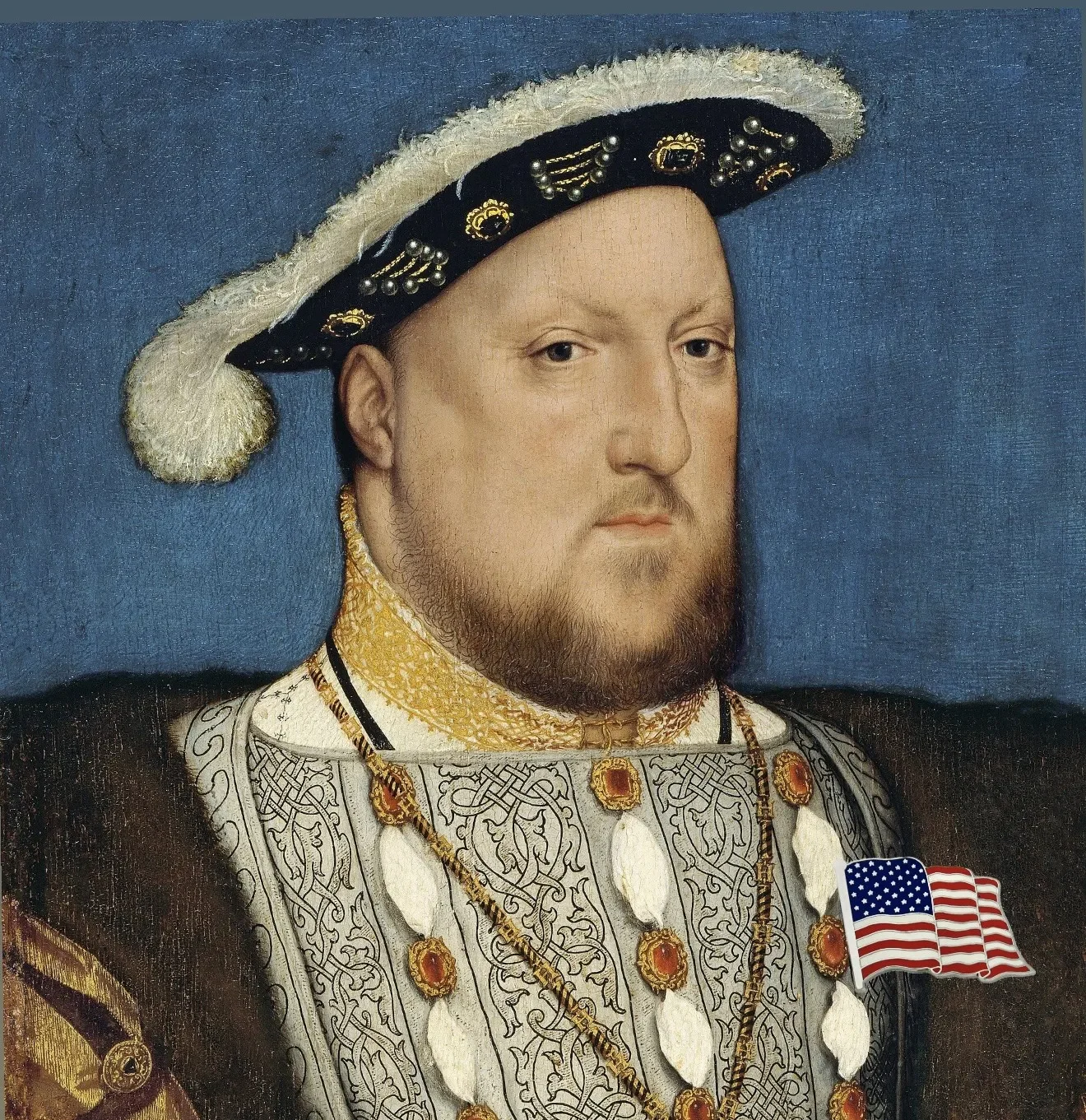
Hans Holbein the Younger, Portrait of Henry VIII of England, c. 1537. MuseoNacional Thyssen-Bornemisza, Madrid. Detail; via Wikimedia Commons. (American flag lapel pin, AI superimposed).
The history of Henry VIII shows how personal vanity, political vengeance, and unquestioned authority can hollow out a nation’s strength. The danger is not simply a leader’s ego, but the damage done when government, advisers, and national resources become instruments of that ego.
I recently returned from two weeks in England, where exploring the legacy of Henry VIII’s reign prompted thought about the future of my own country.
Nearly five hundred years after the death of King Henry VIII, England is still haunted by the shadow of a man who tore through centuries-old institutions, while destroying members of his own family, executing longstanding allies and advisors, and weaponizing government against two of his own wives in barbaric acts of state-sponsored domestic violence, all in pursuit of an increasingly delusional and paranoid ego. He bent the church, Parliament, the legal system, property rights, and rule of law around his personal will. In doing so, he permanently scarred the fabric of English society.
The 21st-century United States is not 16th-century England, and, physical size notwithstanding, Donald Trump is not late-stage Henry Tudor. But my exploration left me thinking about the consequences of a leader leeching money and power for himself while enfeebling the nation he claims to be strengthening.
The similarities in temperament are difficult to ignore. Both men cultivated images of masculine strength and magnificence, demanded extravagant displays of loyalty and adoration, and treated perceived personal slights as matters worthy of political vengeance. Both elevated favored advisers only to turn against them when their usefulness expired or their loyalty came into question. Trump has even described himself as “ruling” America, a revealing choice of words for the occupant of an office who is supposed to serve the public, not reign over it. Henry had subjects. An American president has fellow citizens.
But personality alone isn’t the danger. The danger emerges when the institutions surrounding a leader begin adopting his grievances as their own.
Thomas Cromwell, one of Henry’s most capable advisors, helped transform royal ambitions into law, only to be condemned and beheaded when court politics and royal displeasure turned against him. And his fate offers a warning: faithfully serving a tyrant provides little protection against becoming his next victim.
When disagreement or even an honest mistake invites severe punishment, advisers learn to flatter rather than challenge. Bad news is softened; uncomfortable truths are withheld. My experience in law enforcement and government taught me that someone must be able to say that the intelligence does not support an assumption, an operation will fail, an ally won’t cooperate, or the law prohibits a proposed action. A government that silences those warnings becomes vulnerable to compounding mistakes, while depending on an increasingly erratic single point of failure to navigate.
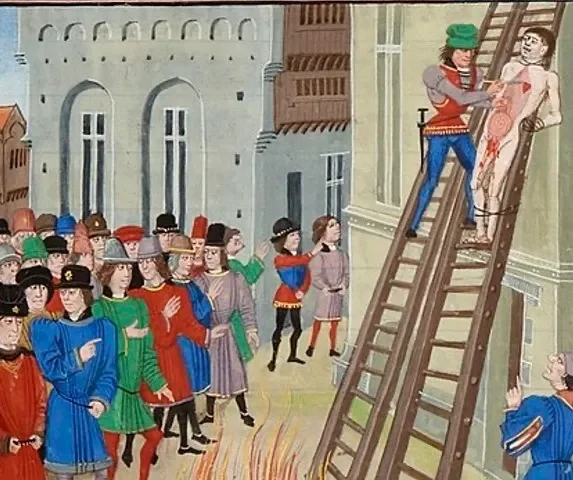
15th-century manuscript of Jean Froissart’s Chronicles. The British Library, London (Royal MS 18 E I, f. 16v).
Henry’s government continued to function. Parliament legislated, courts operated, and administrators carried out their duties. Public executions demonstrated the crown’s capacity to punish. But those institutions, including the executions, increasingly began to serve his personal objectives, fleeting whims, and settling scores.
The Pentagon’s announced (and subsequently withdrawn) plan to publicly execute Nidal Hasan and livestream his death provides a disturbing contemporary echo. His conviction for murdering thirteen people at Fort Hood differs fundamentally from Henry’s political persecutions. But the administration’s original instinct to broadcast his death betrays an innate autocratic desire to turn punishment into a public performance of state power.
Henry’s personal victories were nationally Pyrrhic, coming at tremendous economic cost and violent social disruption. The dissolution of England’s monasteries transferred enormous wealth to the Crown while dismantling institutions that had sustained communities for generations. His costly wars and debasement of English currency further strained the kingdom. Henry strengthened parts of England’s government and military, certainly, but increasing the Crown’s ability to command troops was not the same as strengthening the country.
Following World War II, the United States built a network of alliances, diplomatic relationships, and economic agreements. NATO, intelligence partnerships, and development assistance were never simply acts of charity. They were instruments of national power, enabling America to accomplish with trusted partners what military strength alone could not. These relationships depended on trust, built through diplomacy and adherence to laws and principles, not commanded into existence.
Dismantling institutions like USAID, treating longstanding allies as adversaries, and making American commitments appear contingent upon presidential favor are consuming generations of accumulated goodwill. Our adversaries have stopped believing that we will stand by our friends, and as a result, may choose against standing beside us.
England survived Henry VIII. Its institutions evolved, some recovered, and others disappeared forever. Walking through their remains nearly five centuries later, I was repeatedly reminded that surviving a leader who seeks to rule rather than serve does not mean escaping the consequences of his actions.
We are far from the first to understand these lessons. America’s founders built a republic designed to prevent such concentrations of power. Its survival depends on institutions capable of resisting personal rule, citizens willing to defend them, and leaders who understand that public office is a responsibility, not a possession or birthright.
The lesson of Henry VIII is one of history’s most well-known examples showing that concentrated power in one person will damage their country. A leader pursuing personal power instead of fulfilling his responsibilities diminishes, rather than strengthens, that nation’s strength and security. And the consequences will haunt future generations long after he is gone.
Founded in 2016, The Steady State is a nonprofit 501(c)(4) organization of more than 450 former senior national security professionals. Our membership includes former officials from the CIA, FBI, Department of State, Department of Defense, and Department of Homeland Security. Drawing on deep expertise across national security disciplines, including intelligence, diplomacy, military affairs, and law, we advocate for constitutional democracy, the rule of law, and the preservation of America’s national security institutions.