Hold Fast: Foreign Policy without the Jargon
Diplomacy and alliances may require patience and compromise, but they save American lives, protect our national interests, and spare us the enormous costs of unnecessary war.
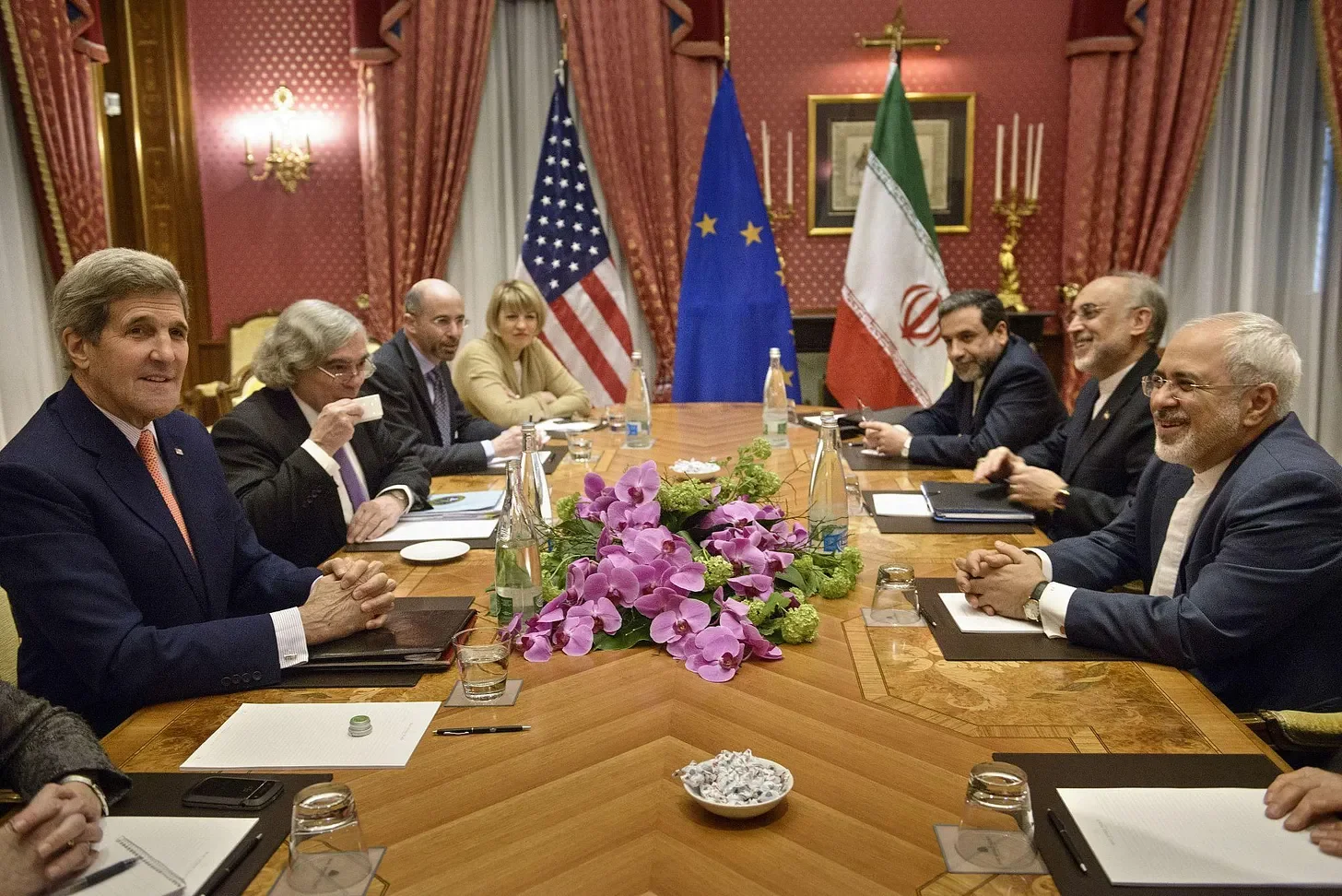
LATimes: Iran nuclear talks leading to the successful Joint Comprehensive Plan of Action in 2015.
Alliances and diplomacy, vital tools of international relations, security, and national self-interest, are the most effective ways to extend the reach of the United States to get what we want and need. When political candidates disrespect our alliances and embrace war as a preferred solution, those actions are red flag indicators that they will heedlessly waste our national resources, including lives and treasure.
Diplomacy exists as a way of maintaining our presence around the world. We have embassies overseas in both friendly and adversarial states, and U.S. diplomats posted to those missions are carrying out very different jobs. In a friendly nation, diplomats look for ways we can work together, within international organizations like the United Nations, through mutually-beneficial commercial trade, or by sharing information about terrorism or pandemics. Meanwhile, diplomats who are posted to an embassy in a country that is unfriendly to our interests are watching for signs of danger long before they hit our shores – reporting threatening developments back to Washington and issuing warnings to the host nation.
Diplomacy is incredibly cost-effective: I can assert with confidence that preventing a war is cheaper than fighting one. Just look at the difference between the cost of negotiating and maintaining a nuclear deterrence agreement with Iran for over ten years, primarily the salaries of diplomats and arms inspectors, versus the cost, in the billions, of the ongoing war with Iran, not even ten months old. Let alone the cost of our most valued treasure: the lives of our miliary.
Creating alliances is a way to join forces with others who want the same things internationally. It makes us stronger to have friends, and weaker when the other side’s alliance is bigger and more united. A bit like a good marriage, alliances can be rocky but will survive if we take the time to understand one another and how to respectfully disagree. Being consistent in our demands on each other means writing down some rules and keeping our promises. Too many random demands or failures to carry out what we promised will lead allies to look for other options. Our alliance with European nations through the North Atlantic Treaty Organization (NATO), dating back to 1949, was rock-solid for many years, but now is threatened. Our closest European allies have seen us betray Ukraine and walk away from commitments. Our alliances in East Asia, particularly with Japan and South Korea, were a cornerstone of our effort to deter Chinese expansionism, but may not withstand a complete about-face on key issues like Taiwan’s integrity or North Korea denuclearization.
To put this in context, I teach my international relations students to envision international relations as a kind of “intensity staircase” – at the base are interactions of peaceful diplomacy, business, and tourism, while at the top are warfare, economic rupture, and the breakdown of international rules. There is two-way traffic; a tense situation can move back towards normal communications; fighting can escalate or end with a cease-fire; an economic dispute can lead to either a new agreement or a tariff wall.
Diplomacy and other forms of international cooperation at the bottom of this “staircase” can appear slow and pointlessly detailed, but they have huge advantages: they hurt fewer people, they are less expensive, and they allow experts time to think and to find areas of agreement. Similarly, alliances are enormously useful in cutting back the costs and risks of carrying out national goals, but they are sometimes frustrating, requiring compromise and sharing credit. “Go it alone” warfare is fast, straightforward, and camera-ready, and elicits powerful emotions: anger, fear, and even national pride. But it brings with it irreversible harm to vulnerable people, unintended consequences like fuel blockades, and generations of trauma, anger, and retribution among the impacted populations, all of which may come back to haunt us or our children.
A voter looking at today’s international landscape may feel buffeted by events, not even sure what being patriotic means when your country’s military is fighting a war that doesn’t make sense. Stirring confusion is can be intentional, particularly when disputes become conflicts of choice; leaders often use the excuse of defending the homeland from a ruthless enemy to further their own political objectives.
For a voter, some questions when considering their congressional candidates:
Does the candidate support / participate in active Congressional oversight of the Executive Branch as concerns both diplomacy and military action?
Does the candidate promote or support “soft power”(diplomacy) as a choice to make us safe?
Does the candidate support using force as a last resort, only after serious and in-depth diplomatic efforts have failed?
What is the least costly, in both the long and short term, of the candidate’s foreign policy choices?
HOLD FAST and VOTE
Founded in 2016, The Steady State is a nonprofit 501(c)(4) organization of more than 450 former senior national security professionals. Our membership includes former officials from the CIA, FBI, Department of State, Department of Defense, and Department of Homeland Security. Drawing on deep expertise across national security disciplines, including intelligence, diplomacy, military affairs, and law, we advocate for constitutional democracy, the rule of law, and the preservation of America’s national security institutions.