The Post Came Down. The Message Didn’t.
What a deleted DHS post reveals about how the government speaks—and whom it tells us to fear.
Twenty-five years after Balbir Singh Sodhi was murdered because of how he looked, a federal agency should understand the power of its words, the stereotypes they can reinforce and the divisiveness they ignite.
On September 15, 2001, Balbir Singh Sodhi was helping a landscaper plant flowers around his gas station in Mesa, Arizona, a tribute to the lives lost to terrorism three days earlier. Frank Silva Roque, fresh from ranting about immigrants at a bar, drove to that gas station and shot Sodhi five times with a .380 handgun, killing him. Roque wanted revenge for 9/11 and racially profiled Balbir as an Arab Muslim because of his turban, beard, and clothing. Roque then fired at the home of a local Afghan family, drove ten miles to another station, and shot at (and missed) a Lebanese-American clerk. Afterward, he bragged at a bar that police were “investigating the murder of a turban-head down the street.”
This was the first post-9/11 federal hate crime — the victim a Sikh-American, mistaken for Arab Muslim. A few years later, The Department of Homeland Security (DHS) Office for Civil Rights and Civil Liberties (CRCL) launched national community engagement efforts on articles of faith, including posters on Sikh articles of faith. Their first principle: “show RESPECT” and “do no harm.” I was part of the effort supporting that work. It wasn’t perfect, but it helped unify a nation struggling to rebuild while holding onto its ideals.
Government credibility isn’t a birthright, it’s earned sentence by sentence, and it can be spent recklessly in a single post. Words were chosen carefully then, because someone at DHS understood a federal agency doesn’t speak the way an angry man at a bar speaks.
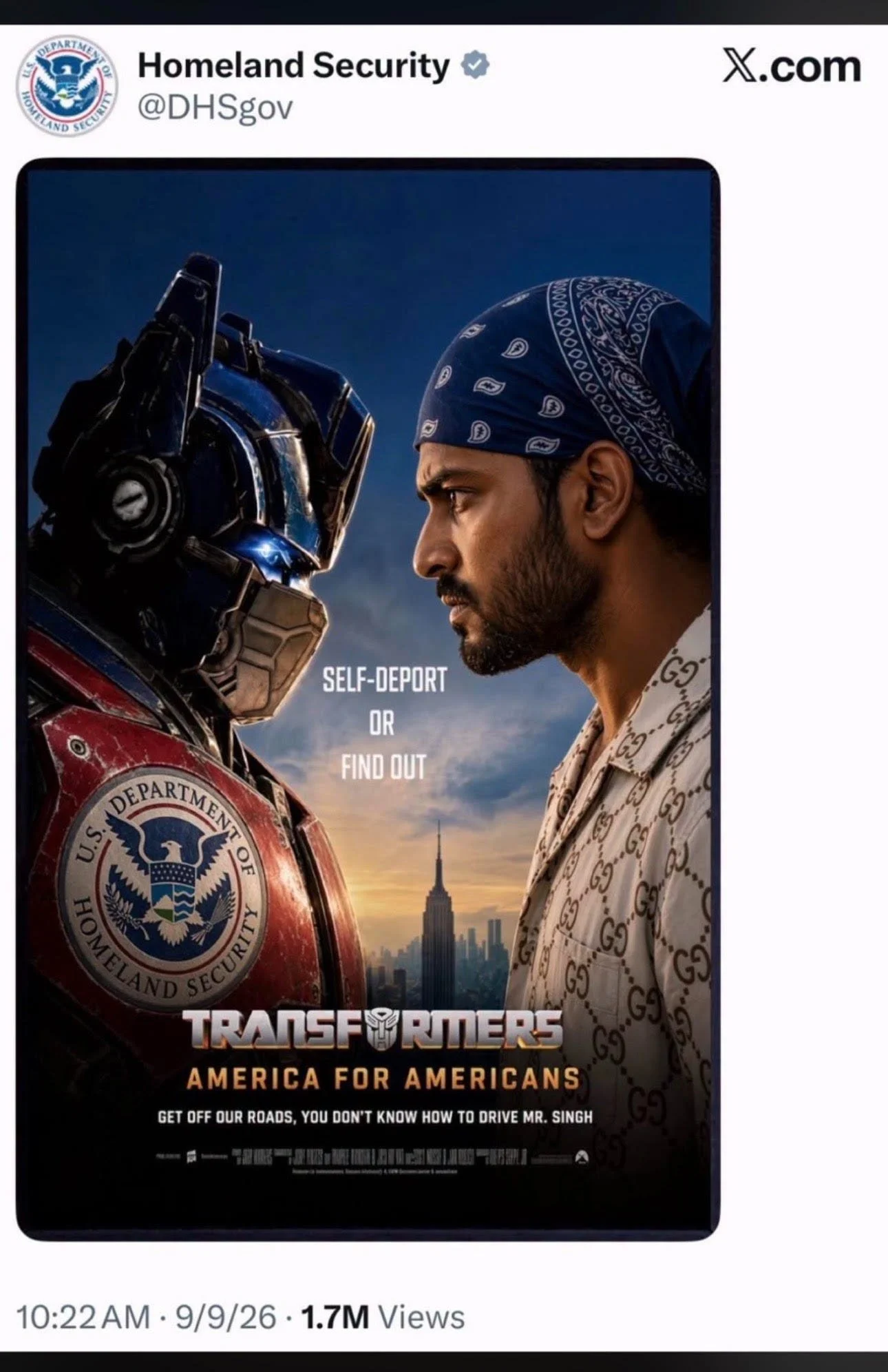
Earlier this month, on September 9, 2026, two days before the 25th anniversary of 9/11, DHS published, then deleted, a different kind of message. It featured an AI-generated image of a turbaned, bearded man labeled “Mr. Singh,” confronted by a DHS-branded Optimus Prime, over the words “America for Americans. Get off our roads; you don’t know how to drive, Mr.; Singh” and “Self-deport or find out.”
“Singh” is one of the most common surnames among Sikh Americans. Whatever the intended target, DHS said it referenced a specific driver facing charges; the imagery reached for the same shorthand that got Balbir killed in 2001— a beard, a turban, a name standing in for a threat. When backlash came, DHS didn’t walk it back, calling the criticism “nonsensical drivel” and “faux outrage.” That second choice of words matters as much as the first.
25 years apart, two ways an agency can talk to the country it serves. One asks people to lead with respect and do no harm. The other reaches for a stereotype as a punchline, then dismisses those who recognized it. The post came down. The pattern it revealed did not.
As a DHS veteran of over 14 years, I feel shame, disappointment and concern knowing some will use this as another excuse for violence, targeting people for their appearance or faith. Words from a federal agency are never just words — they’re instructions on who counts as “American.” After Balbir Singh Sodhi, DHS should know exactly what those instructions can cost.