When the president elevates AI above human intelligence, his claim to be its indispensable guardian raises a troubling question about the future of democratic sovereignty.
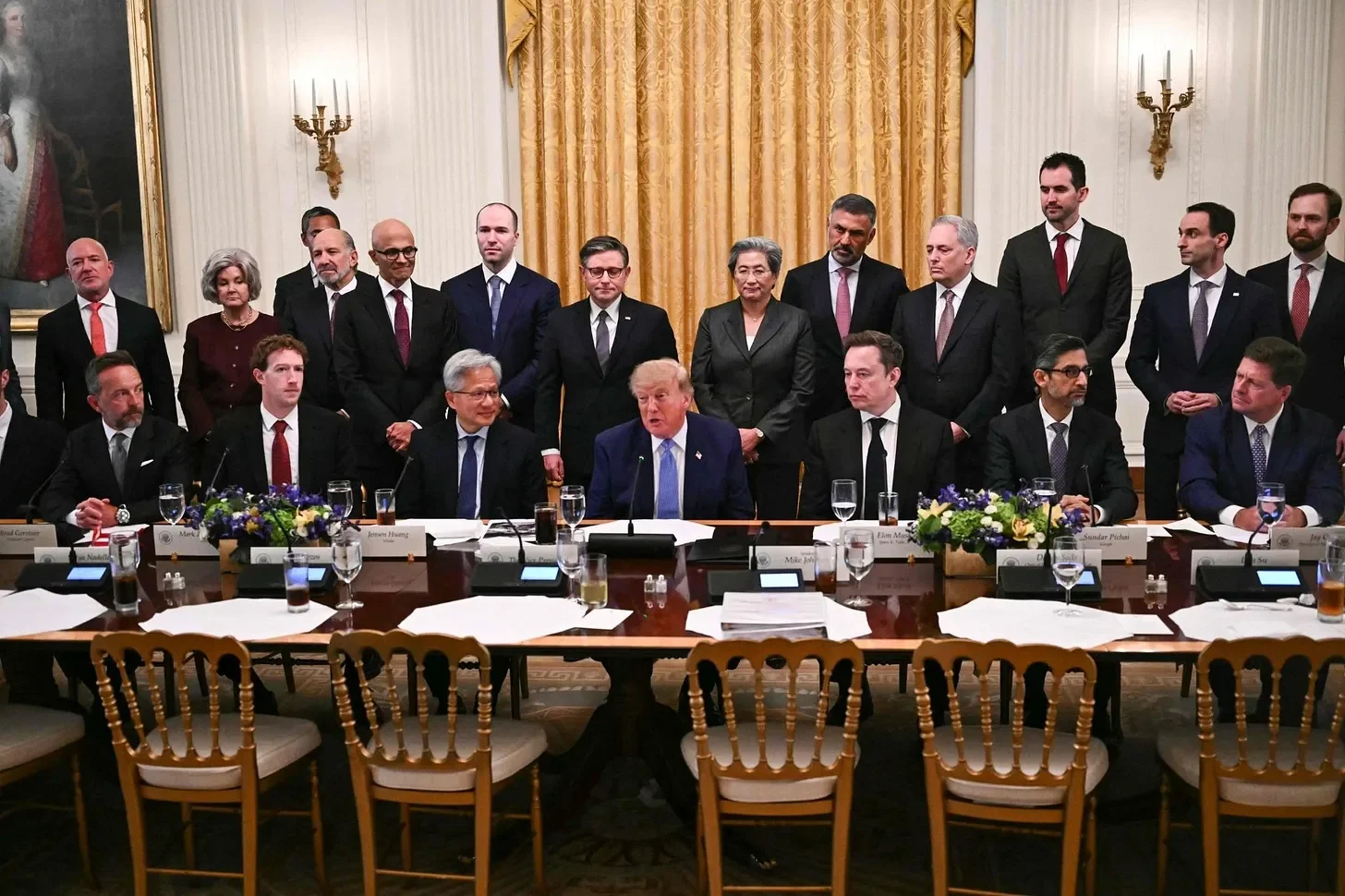
Trump meets with top tech CEO’s on September 29, 2026 Photo: AFP
The debate over artificial intelligence is also becoming a debate over sovereignty. If AI is imagined as a superior intelligence rather than a human-created technology, who gets to govern it? And why does Trump seem to believe that person should be him, alone?
Something curious, and potentially consequential, is happening in the language of the American presidency. President Donald Trump has taken to describing what we conventionally call “artificial intelligence” as “superior intelligence.” It is characteristic of Trump’s norm-breaking vocabulary: the technical becomes personal, hierarchical and superlative. But in this instance the break with convention deserves particular attention because Trump is adopting a language increasingly familiar among the technological elite itself; a language in which AI is discussed less as a tool to be used by humans than as an emerging intelligence whose capacities may exceed, and perhaps ultimately stand above, our own. Not a servant, but a colleague, perhaps even a master.
The distinction matters. “Artificial intelligence” describes an artifact: something human beings have made and therefore something human institutions may govern. “Superior intelligence” describes a hierarchy. There is an intelligence above and an intelligence below, and we are below. Once that hierarchy is accepted, an ancient political question reappears in startlingly modern form: what is the proper relationship of the inferior to the superior?
This vocabulary recalls political arrangements that democracy was supposed to have displaced. A subordinate lord addressed a king differently from an equal. A tributary ruler approached an emperor with ritualized deference. The words themselves established the hierarchy before the sovereign issued a command.
But Trump introduces another element. His posture toward AI regulation increasingly presents the president himself as the indispensable actor, as though ordinary institutions, legislators, regulators and perhaps even other political leaders are inadequate to the task. Indeed, he stated as much in his September 14, 2026 comments as he refused to consider requested oversight of AI: “The only control or ‘guardrails’ that AI needs is a STRONG AND SMART (High IQ!) PRESIDENT, and the U.S.A. has that, in spades!” Perhaps the imagined relationship is not simply humanity subordinated to a superior intelligence. Perhaps Trump imagines a hierarchy in which he occupies a privileged position between the two.
There are older models for that arrangement as well. One is feudal: the senior lord is permitted to deal directly with the sovereign while lesser figures remain below and apart. Another is religious: the intermediary claiming a distinctive authority to interpret or negotiate humanity’s relationship with a higher power: the pontiff between God and the flock.
None of these analogies should be taken literally. Trump is not consciously pledging fealty to a machine, and Silicon Valley is not establishing a church. But political language often changes before political arrangements do. The striking fact is that the president and some of the enormously powerful people building these systems increasingly speak of artificial intelligence as though it were not merely technology but an independent superior force to which humanity must adjust.
That makes the question larger than semantics. Where does the president imagine this hierarchy leading, and where does he imagine himself within it? Is Artificial Intelligence an instrument governed by a democratic society? Or is “Superior Intelligence” an emerging sovereign with which political leaders must negotiate? Or does Trump imagine himself as the uniquely qualified intermediary, the man entitled to approach the new superior intelligence on behalf of everyone else?
For a republic founded on the proposition that sovereignty ultimately resides in the people, that is a peculiar, and deeply unsettling, way to begin talking about the future.
Founded in 2016, The Steady State is a nonprofit 501(c)(4) organization of more than 450 former senior national security professionals. Our membership includes former officials from the CIA, FBI, Department of State, Department of Defense, and Department of Homeland Security. Drawing on deep expertise across national security disciplines, including intelligence, diplomacy, military affairs, and law, we advocate for constitutional democracy, the rule of law, and the preservation of America’s national security institutions.