Civic Witness Series - Questions from the Attic
How do we stop treating distrust as stupidity?

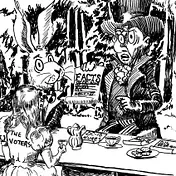
Civic Witness Series: Questions from the Attic, is founded on a simple premise: the people living through democratic erosion have questions the ‘experts’ aren’t addressing; it is inspired by and in honor of Adia in the Attic. Those questions matter because they provide an opportunity for sharing and documenting what democratic erosion feels like to people living through it. We don’t pretend to have “The Answer” to these questions, but we hope to stimulate the conversation her questions have prompted.
How do we stop treating distrust as stupidity?
With Donald Trump doing some unbelievably disruptive things each passing hour, or so it seems, and his core of support hanging together, albeit with a significant decline in his overall popularity, it’s all too easy to dismiss Trump supporters as a bunch of stupid people who are beyond redemption. If, however, we’re ever to restore a sense of American identity and community, that is a trap we should avoid. We need to look beyond the rhetoric and vitriol and understand why roughly 77.3 million voters cast their ballots for Trump in 2024. This, despite his inept handling of the COVID-19 pandemic and two impeachments during his first term (2017-2021). There is something besides stupidity that would cause such an outcome.
Digging deeper reveals that there is. Let’s start with the 2016 election: the breakdown of Trump supporters and their motivations. In 2016, Trump won the Electoral College (306 to 232) but lost the popular vote, becoming the fifth president in the nation’s history to lose the popular vote but still win the election (his opponent, Hillary Clinton, received 2.8 million more votes.) He did that by connecting with a solid base. He won 58 percent of the Anglo-white vote, 53 percent of men, 53 percent of people over 44, and 53 percent of people without a college degree. Trump’s appeal in 2016 was to those who hadn’t recovered from the 2008-09 recession, those who had lost high-paying factory jobs, evangelical Christians, abortion opponents, gun owners, and ordinary people who felt ignored or neglected by the Washington establishment and Wall Street. In other words, for the most part, people supported Donald Trump, not necessarily because they thought he was better than the alternatives, but because he was not the alternative. They had lost trust in government and feared for the future.
Now, fast forward to 2024: another female opponent, Vice President Kamala Harris, lost to Trump by 1.5 percentage points in the popular vote (77.3 million to 75.0 million), winning 312 Electoral College votes and a slight edge in the popular vote. In 2024, Trump voters were more racially and ethnically diverse than in 2016 or 2020, but this was due more to higher turnout than in those two elections. What, though, motivated people to vote for him? Beyond polarized messaging throughout the campaign, which appealed to voters motivated by identity, grievance, and distrust of elites, economic anxiety and the feeling that the ‘system’ was not working for them ranked high. In other words, fear and distrust loomed large in the minds of people when it came time to cast their ballots.
Since taking office in January 2025, Trump’s actions have further undermined Americans’ trust in their government. While his popularity is at its lowest, with 38 percent overall approving (87 percent of Republicans approve) and 58.5 percent disapproving, his base remains loyal. This loyalty is thought to stem more from identity politics than anything else.
The point is not to excuse every choice made by Trump supporters, nor to ignore the harm caused by leaders who exploit fear, anger, and mistrust for political gain. It’s to recognize that millions of Americans cannot be reduced to a single stereotype. Some are motivated by cultural resentment or partisan loyalty, but many others feel economically insecure, socially displaced, unheard by institutions, or convinced that government no longer works for them. Some are rural, some suburban, some working class, some prosperous, some white, and some are even Black, Latino, Asian American, and immigrant voters as well. Treating all of them as ignorant or morally hopeless only deepens the alienation that helped create Trump’s appeal in the first place.
While it’s not a medical diagnosis, Trump exhibits clear tendencies of sociopathy, a condition that affects roughly 1 to 3 percent of the general population. People are often drawn to sociopaths because of their unpredictable behavior and manipulative skills—which certainly describes Trump.
If we want healthier politics, we have to learn to distinguish between the demagogue and the people drawn to him. That means listening without surrendering our principles, challenging falsehoods without humiliating people, and offering practical proof that democratic government can still solve real problems.
Rebuilding trust will require more than better messaging. It will require visible competence: affordable health care, decent wages, safer communities, fair treatment under the law, and leaders who show respect for people outside their own coalition. It will also require face-to-face civic habits—local meetings, community service, schools, churches, unions, veterans’ groups, and neighborhood organizations, where people can encounter one another as neighbors rather than caricatures.
The way forward is not to romanticize Trump supporters or condemn them all. It is to understand the fears and distrust that move many of them, answer those concerns honestly, and make democracy feel less distant and more real.